Latest price and news from the crypto space
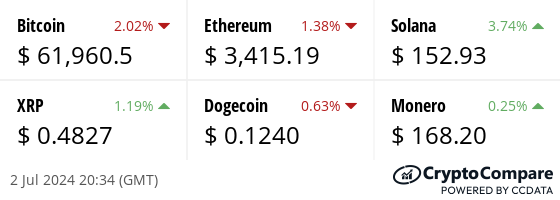
Latest price from our hand picked list of digital assets
 

 Top stories in today’s Crypto Roundup:

  • Binance partners with Paxos to launch U.S. dollar-backed stablecoin.
  • Paxos PAX Gold becomes first tokenized gold product to receive regulatory approval.
  • Bitcoin network facilitates a transaction worth over $1 billion.

BTC/USD pushed higher by roughly $200 overnight (UTC). For the third time over the past two days, the 50 EMA on the hourly timeframe served as key support. The BTC/USD pair’s RSI (i.e., 68) is closing in on ‘overbought’ territory (i.e., 80 or higher) on the four-hour timeframe.

At the time of writing, bitcoin (BTC) is trading at $10,716.9 (+1.81%) with a daily trusted volume of $1.23 bn. As for ether (ETH) it is trading at $175.6 (+0.7%) with a daily trusted volume of $220.16 mn. The MVIS CryptoCompare Digital Assets 10 Index is currently tracking at 3,207.60 (+1.41%).
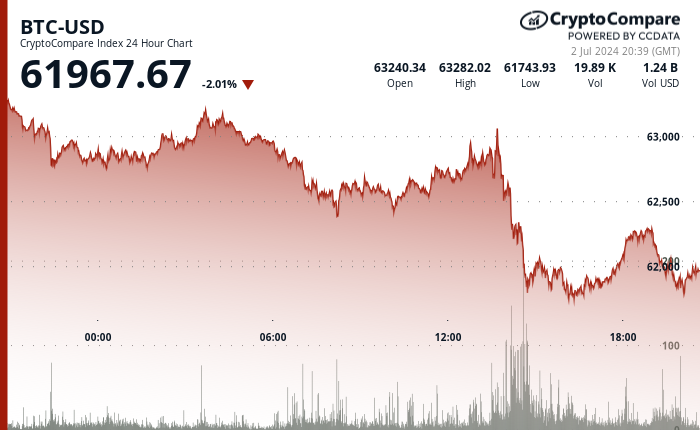
 
24 hours chart of the price of BTC
 

Binance USD (BUSD) Stablecoin Greenlighted by New York Regulator


The world’s largest cryptocurrency exchange operator by traded volume, Binance, partnered with multi-faceted blockchain company Paxos Trust Company to launch Binance USD (BUSD), a U.S. dollar-denominated stablecoin.

The announcement from Binance coincided with the New York State Department of Financial Services’ (NYDFS’), which declared it had authorized Paxos to offer two new asset-backed tokens, one being BUSD.

According to Binance’s BUSD announcement, BUSD will go live later in September “on the Paxos platform for direct purchase and redemption 1:1 for U.S. dollars and available on Binance.com for trading initially against BTC, BNB and XRP.” Before then, additional details regarding the partnership between Binance and Paxos will be “revealed on-stage at Invest: Asia 2019,” the exchange operator teased.

 
Read More
 

Paxos’ PAX Gold Becomes First Tokenized Gold Product to Receive Regulatory Approval


As for Paxos’ second asset-backed token that it had authorized on Thursday by the NYDFS, it pertained to PAX Gold (PAXG), a tokenized version of gold that represents real, physical gold.

Commenting on the NYDFS’ decision, Paxos chief executive and co-founder Charles Cascarilla stated that his New York-chartered trust company “are grateful for the opportunity to offer PAX Gold, the first tokenized gold product to receive regulatory approval. By releasing this regulated product that makes it easy to own or trade gold, we’re using blockchain technology to democratize access to a multi-trillion-dollar market and bring gold into the digital future.”

In its PAX Gold whitepaper—last updated on September 5, 2019—Paxos revealed that because it has managed to build relationships with large institutions in the gold market over the years, “it has been able to secure partnerships with top gold providers, vaults and miners to ensure PAX Gold is only supported by the highest-quality gold and stored in some of the most reliable vaults in the world.”

 
Read More
 

Bitcoin Network Facilitates Transaction Worth Over $1 Billion


On Friday morning—specifically, at 3:30 am (UTC) - the Bitcoin network processed a transaction of 94,504 bitcoin (BTC); the U.S. dollar-equivalent of slightly above $1 billion. The associated transaction fee was roughly $700, which translates to roughly 0.00007 percent of the total amount of BTC transferred. With the current supply of BTC at 17,918,512 according to CryptoCompare data, the 94,504 BTC transferred represents 0.527 percent of current supply.

Commenting on the enormous transaction via Twitter at 5:44am was Nick Szabo, the computer scientist, legal scholar, and cryptographer who invented smart contracts. “Such confidence in Bitcoin is splendid,” he acknowledged, before noting that “a 94,500 BTC [transaction] tempts fate. If [the] recipient can make that much from reversing the [transaction], they can afford to run a 51% attack for more than 40 days.”

A 51% attack is a potential attack on a blockchain network (e.g., Bitcoin) where a single entity is able to control the majority of the hash rate, potentially causing a network disruption. If this were to happen, the attacker would have enough mining power to intentionally exclude or modify the ordering of transactions. Additionally, attackers could reverse transactions they made while being in control of the given blockchain, leading to a so-called double-spending problem.

In (likely) related news, economist and trader Alex Kruger tweeted at 5:09am that BTC from the largest non-exchange Bitcoin address “is on the move (or so it seems).”

 
Read More

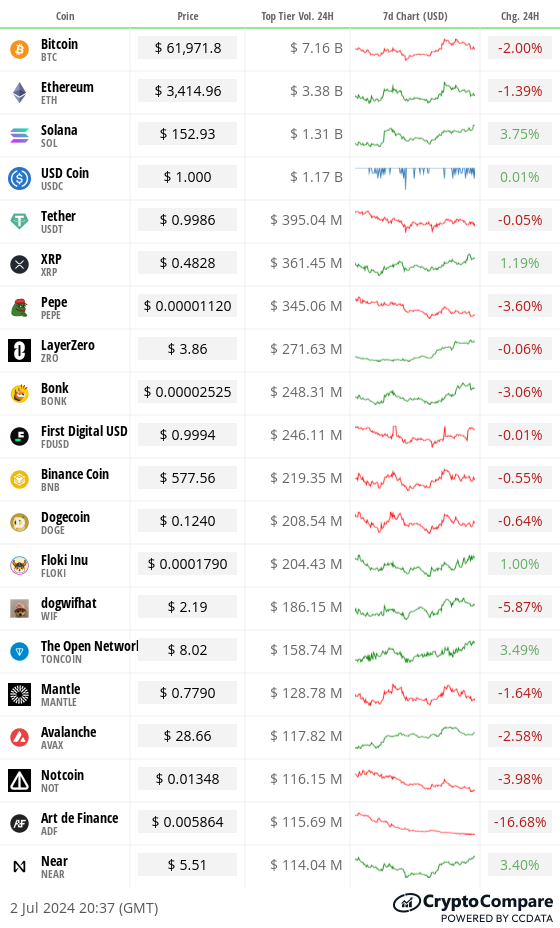
State of the Crypto by Top Tier Exchange Volume

Toplist 20 coins by top tier volume

Build your project with CoinDesk Data

 
social icon twitter social icon linkedin
 

Terms | Privacy

13 Charles II St, SW1Y 4QU

London, UK

This email may include advertisements by third parties. None of the advertised or promoted products and services have been verified or approved by us and this email is not any endorsement by us of the third party or of their products or services.


Download our App from the google play store
 
 
Download our App from the apple store