Latest price and news from the crypto space
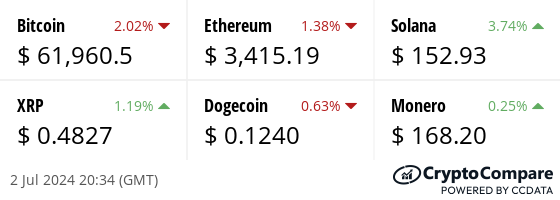
Latest price from our hand picked list of digital assets
 

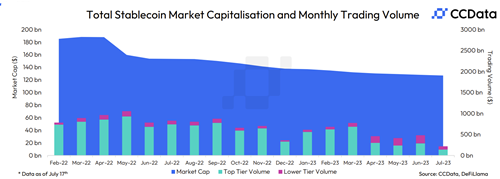
The total market capitalization of the stablecoin sector has now been dropping for 16 consecutive months, to hit its lowest level since August 2021, according to CCData’s latest Stablecoins & CBDCs report.

Senior House Republicans have introduced an extensive bill aimed at bringing substantial changes to the cryptocurrency landscape in the U.S. The legislation, called "the Financial Innovation and Technology for the 21st Century Act," mandates the creation of clear definitions for "blockchain" and "digital asset" within existing financial law, and for the creation of rules specifically for crypto exchanges.

The U.S. Federal Reserve has recently moved to dispel the notion that its forthcoming FedNow Service, designed to expedite payments between organizations, is tied to central bank digital currencies (CBDCs).

Top stories in the Crypto Roundup today:

  • Stablecoin Market Cap Hits Lowest Level in Nearly Two Years
  • House Republicans Introduce Crypto Bill to Define and Regulate Digital Assets
  • FedNow Instant Payment Service is Not CBDC-Related, Federal Reserve Clarifies
  • Crypto Market Movers – BCH, COMP, XLM
 
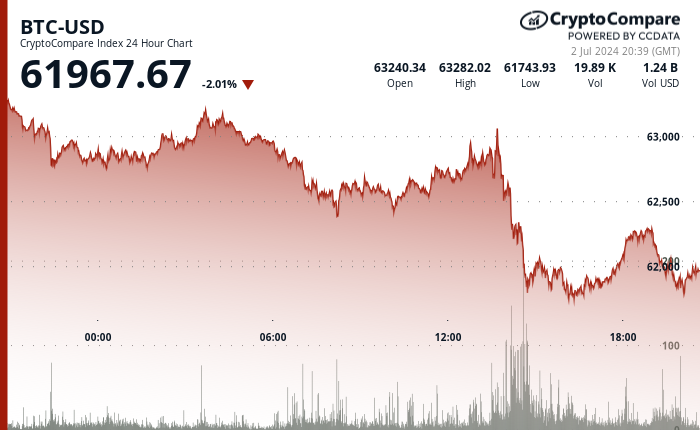
24 hours chart of the price of BTC
 

Stablecoin Market Cap Hits Lowest Level in Nearly Two Years


The total market capitalization of the stablecoin sector has now been dropping for 16 consecutive months, to hit its lowest level since August 2021, according to CCData’s latest Stablecoins & CBDCs report.

The report details that the stablecoin market cap fell 0.82% from the start of the month until July 17, with Tether’s USDT now accounting for 65.9& of the stablecoin sector’s market capitalization.

The market capitalization of USDC and BUSD has kept on declining, falling 3.01% and 4.57% to $26.9 billion and $3.96 billion respectively, in what was the seventh consecutive monthly decline for USDC, which reached its lowest market capitalization since June 2021.

The market dominance of the stablecoin sector has meanwhile fallen to 10.5% in June, which is far below its all-time high of 16.6% seen in December 2022. Trading volumes nevertheless rose last month to $482 billion.

Volumes rose after multiple TradFi giants, including BlackRock and Fidelity, filed for spot Bitcoin exchange-traded funds (ETFs), in the first increase in monthly stablecoin trading volumes since March 2023.

 
Read More
 

House Republicans Introduce Crypto Bill to Define and Regulate Digital Assets


Senior House Republicans have introduced an extensive bill aimed at bringing substantial changes to the cryptocurrency landscape in the U.S. The legislation, called "the Financial Innovation and Technology for the 21st Century Act," mandates the creation of clear definitions for "blockchain" and "digital asset" within existing financial law, and for the creation of rules specifically for crypto exchanges.

Encompassing over 200 pages, the bill stipulates that both the Securities and Exchange Commission (SEC) and the Commodity Futures Trading Commission (CFTC) would be obligated to create unique regulations for digital asset trading platforms and exchanges.

Notably, the bill ensures that regulatory authorities would not be able to create rules on how individuals can personally hold digital assets. It would also provide digital asset projects with exemptions from the usual securities offering registrations, within certain limits.

This would allow issuers to offer up to $75 million worth of tokens in a 12-month period, although restrictions on sales to unaccredited investors — a group that most buyers belong to — would apply.

Issuers would still be required to submit documentation to the SEC, including biannual and annual reports on the project, unless regulators have certified it as sufficiently decentralized for the token to qualify as a commodity.

The new bill contains provisions to safeguard customer assets and funds, including a clear prohibition against the mixing of customer assets, a charge previously leveled against FTX and other large crypto companies. It also places restrictions on token issuers.

 
Read More
 

FedNow Instant Payment Service is Not CBDC-Related, Federal Reserve Clarifies


The U.S. Federal Reserve has recently moved to dispel the notion that its forthcoming FedNow Service, designed to expedite payments between organizations, is tied to central bank digital currencies (CBDCs).

The central bank confirmed that the service functions within the current fiat system, akin to existing payment services such as Fedwire and FedACH. Its statement came in response to speculation around the nature of the FedNow Service, given its ability to facilitate instantaneous fiat transactions and real-time gross settlement (RTGS).

The Fed has deemed the FedNow Service "ready" after enlisting 41 financial institutions, 15 service providers, and the U.S. Department of the Treasury for a pre-launch test.

Despite the near-term debut of this instant payment service, slated for the end of July 2023, the Federal Reserve asserted that it has yet to make a decision regarding the issuance of a much-anticipated CBDC, indicating that such a move would require an authorizing law.

 
Read More
 

Crypto Market Movers – BCH, COMP, XLM
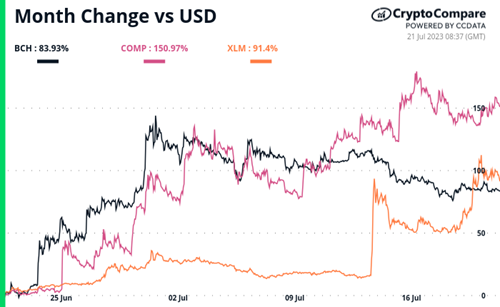
 

Several tokens are leading the charge in the last 7-day period. Some of these are well-known cryptocurrencies with more liquid trading pairs, so we’ll be focusing on these over low-cap cryptos that may have higher percentage changes.

Bitcoin Cash (BCH) - Bitcoin Cash (BCH) is a cryptocurrency that was created in August 2017 as a result of a hard fork of the Bitcoin blockchain. It is a decentralized, peer-to-peer digital currency that is based on the same underlying technology as Bitcoin, but it has a number of differences that make it unique.

Compound (COMP) - Compound Governance Token (COMP) is the native token of the Compound protocol, a decentralized lending and borrowing platform built on the Ethereum blockchain. The platform allows users to lend and borrow a variety of cryptocurrencies, including Ethereum, USDC, and DAI. COMP token holders have the power to govern the Compound protocol by proposing and voting on changes to the platform's parameters and features.

Stellar (XLM) - Stellar is an open-source, decentralized blockchain network designed to facilitate the transfer of money and other assets between people and institutions across the world. It was created to enable fast and efficient cross-border transactions, with low fees and without the need for traditional financial intermediaries. 

 
Read More

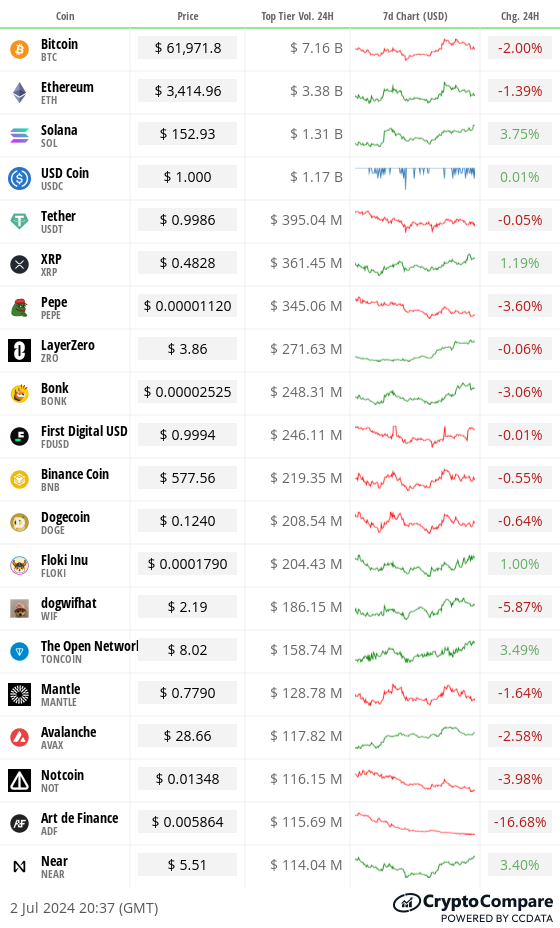
State of the Crypto by Top Tier Exchange Volume

Toplist 20 coins by top tier volume

Build your project with CoinDesk Data

 
social icon twitter social icon linkedin
 

Terms | Privacy

13 Charles II St, SW1Y 4QU

London, UK

This email may include advertisements by third parties. None of the advertised or promoted products and services have been verified or approved by us and this email is not any endorsement by us of the third party or of their products or services.


Download our App from the google play store
 
 
Download our App from the apple store