Latest price and news from the crypto space
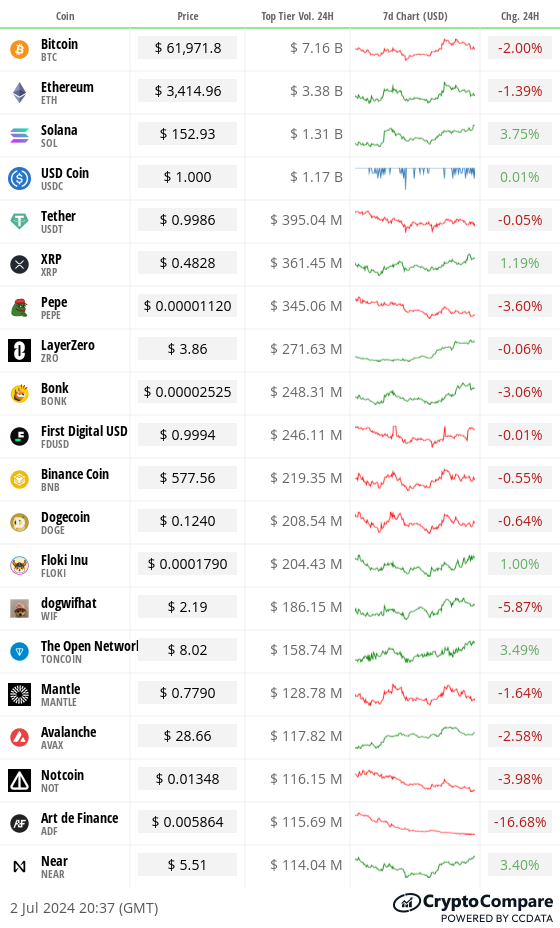
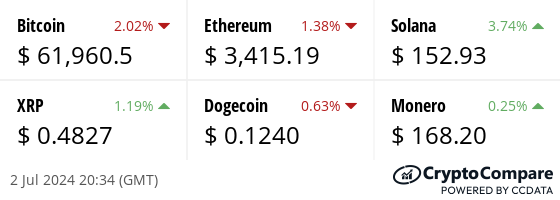
Latest price from our hand picked list of digital assets
 

Bitcoin's recent price correction, following a relentless rally, has mirrored weakness in traditional markets. Bitcoin has exhibited a surprising lack of panic, while volatility gauges for stocks and bonds spiked noticeably.

The U.S. Securities and Exchange Commission (SEC) is seeking billions of dollars in penalties against Terraform Labs and its co-founder Do Kwon, following a jury verdict finding them liable for fraud.

Venezuela's state-owned oil company, PDVSA, is ramping up its use of digital currencies in oil sales as the U.S. reimposes oil sanctions on the country.

Top stories in the Crypto Roundup today:

  • Bitcoin Sees Lower Volatility Despite Market Downturn
  • SEC Seeks Billions in Penalties from Terraform Labs, Do Kwon After Fraud Verdict
  • Venezuela Turns to Crypto as U.S. Oil Sanctions Bite Back
  • Spot Bitcoin ETF Supply Dynamics and Halving Implications
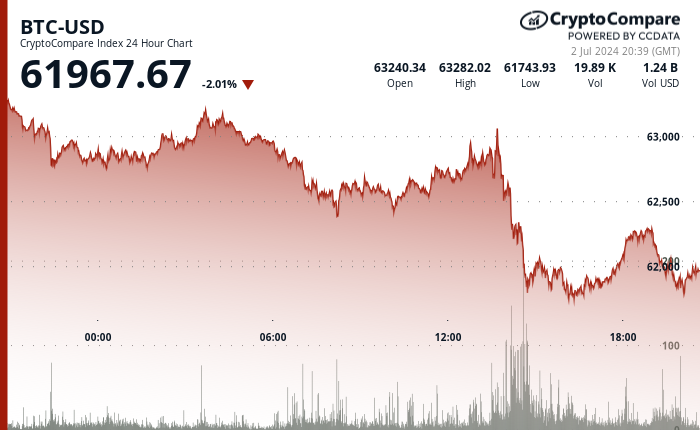
 
24 hours chart of the price of BTC
 

Bitcoin Sees Lower Volatility Despite Market Downturn


Bitcoin's recent price correction, following a relentless rally, has mirrored weakness in traditional markets. Bitcoin has exhibited a surprising lack of panic, while volatility gauges for stocks and bonds spiked noticeably.

Despite a 7% price drop for Bitcoin this month, options markets haven’t seen a surge in demand for downside protection, unlike traditional markets, with Deribit’s BTC VOL index, an options-based expected volatility gauge, even dropping from 75% to 70%.

The contrast is evident when comparing Bitcoin's implied volatility, a measure of expected price swings, with the Chicago Board Options Exchange’s VIX, a volatility gauge for the S&P 500 stock index, as the VIX has jumped significantly from an annualized 13% to 19%, reflecting heightened anxiety among stock market investors.

Bitcoin’s muted volatility gauges, however, aren’t necessarily a sign of inherent stability, as historically BTC’s implied volatility has been positively correlated with its price. When its price goes up, volatility tends to rise as well, and vice versa.

This dynamic suggests that Bitcoin’s volatility could rise, should its uptrend resume. On top of that the MOVE index, which measures the expected volatility in U.S. Treasuries, rose from 94% to 111% while bond prices declined, with a rise in the MOVE index often leading to tighter financial conditions as investors take a risk-off approach.

Since Treasuries are used as collateral for borrowing to invest with leverage in riskier assets like stocks, increased volatility in this market can lead to reduced leverage and liquidity, potentially squeezing both stocks and Bitcoin.

 
Read More
 

SEC Seeks Billions in Penalties from Terraform Labs, Do Kwon After Fraud Verdict


The U.S. Securities and Exchange Commission is seeking billions of dollars in penalties against Terraform Labs and its co-founder Do Kwon, following a jury verdict finding them liable for fraud.

In a filing on April 19 with the U.S. District Court for the Southern District of New York, the SEC requested Terraform and Kwon pay roughly $4.7 billion in disgorgement and prejudgment interest, along with $520 million in civil penalties – $420 million from Terraform Labs and $100 million from Kwon himself.

These figures stand in stark contrast to the much smaller amounts suggested by the defendants, as Terraform proposed a maximum penalty of $3.5 million, while Kwon offered only $800,000.

The SEC's filing goes beyond just financial penalties and proposes barring Kwon from serving as an officer or director of any securities issuer and requires him to disclose details of his accounts and assets. Terraform Labs would face a "conduct-based injunction," designed to prevent the organization from “engaging in essentially the same behavior that led to the massive fraud.”

The Commission emphasized the seriousness of the alleged offenses, stating that the “defendants have not shown remorse for their conduct," and raising concerns about potential future violations. The filing calls for a strong judicial message to deter similar misconduct and attempts to circumvent securities laws in the cryptocurrency market.

 
Read More
 

Venezuela Turns to Crypto as U.S. Oil Sanctions Bite Back


Venezuela's state-owned oil company, PDVSA, is ramping up its use of digital currencies in oil sales as the U.S. reimposes oil sanctions on the country.

The U.S. Treasury Department tightened restrictions by making it harder for Venezuela to trade oil after giving PDVSA’s customers and providers until the end of next month to wind down transactions under a license it did not renew. Companies will now need individual U.S. authorizations to do business with the country.

PDVSA has reportedly been moving oil sales to USDT as it aims to reduce the risk of sanctions freezing proceeds in foreign bank accounts. Despite the shift the U.S. dollar is still dominant in global oil markets, with cryptocurrency transactions remaining uncommon.

However, Venezuelan Oil Minister Pedro Tellechea has acknowledged the potential of digital currencies as a payment method, revealing that in some contracts cryptocurrencies may be a preferred payment method.

Notably, PDVSA was rocked by the 2022 corruption scandal that revealed billions in unaccounted receivables for oil exports, partially involving other cryptocurrencies. Nevertheless, the firm is now requiring prepayment in USDT for half the value of each oil cargo for certain spot sales not involving swaps.

The firm is also requiring new customers applying to conduct oil transactions to hold cryptocurrency in a digital wallet, with the requirement even being enforced in some old contracts that didn’t specify the use of USDT.

However, these USDT demands have created hurdles. Some traders rely on intermediaries to navigate these cryptocurrency transactions as they don’t pass compliance departments, leading to a reliance on middlemen that would hurt PDVSA’s bottom line.

 
Read More
 

Spot Bitcoin ETF Supply Dynamics and Halving Implications
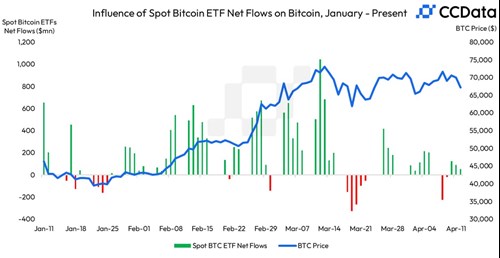
 

The recent launch of spot Bitcoin exchange-traded funds (ETFs) in the U.S. has shaken up the supply dynamics of the world's leading cryptocurrency which, coupled with the limited and predictable issuance schedule of Bitcoin itself, has created a unique dynamic.

Since their debut in January, these ETFs have collectively gobbled up a staggering $752 million worth of Bitcoin, which translates to nearly 900,000 BTC, currently valued at over $53 billion. That's a significant chunk of the available supply, accounting for more than 4.25% of all circulating Bitcoin.

These ETFs are soaking up a sizable amount of Bitcoin from the market at a time in which the supply of new coins being minted was halved.

Dig deeper via CCData’s latest blog post Bitcoin Halvent Event: A Cyclical Catalyst.

 
Read More
 

Crypto tax deadline extension?

IRS crypto taxes are due by Oct 16! Get it right with Koinly's crypto tax software. Simply connect your platforms to Koinly & import your transactions fast! Koinly calculates your gains, losses & income - accurately! Download IRS tax forms and file!

 
Start Now
 

Press Release

State of the Crypto by Top Tier Exchange Volume

Toplist 20 coins by top tier volume

Build your project with CoinDesk Data

 
social icon twitter social icon linkedin
 

Terms | Privacy

13 Charles II St, SW1Y 4QU

London, UK

This email may include advertisements by third parties. None of the advertised or promoted products and services have been verified or approved by us and this email is not any endorsement by us of the third party or of their products or services.


Download our App from the google play store
 
 
Download our App from the apple store