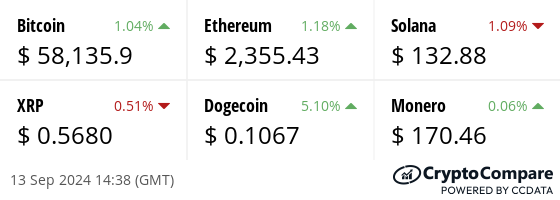
Latest price and news from the crypto space
Latest price from our hand picked list of digital assets
 

The U.S. Treasury Department has formally withdrawn a 2020 proposal to impose know-your-customer (KYC) requirements on non-custodial crypto wallets.

Senior District Judge William H. Orrick of the U.S. District Court for the Northern District of California ruled on August 23 that the SEC has plausibly alleged that some cryptocurrency transactions facilitated by Kraken may qualify as investment contracts.

The arrest of Telegram founder and CEO Pavel Durov in France has led to a significant drop in the value of the cryptocurrency Toncoin ($TON), which is closely connected to the Telegram messaging platform through The Open Network (TON).

Top stories in the Crypto Roundup today:

  • U.S. Treasury Withdraws Proposal for KYC Requirements on Unhosted Crypto Wallets
  • U.S. District Judge Says SEC's Lawsuit Against Crypto Exchange Kraken Must Proceed
  • TON Price Plummets After Telegram Founder and CEO Pavel Durov’s Arrest in France
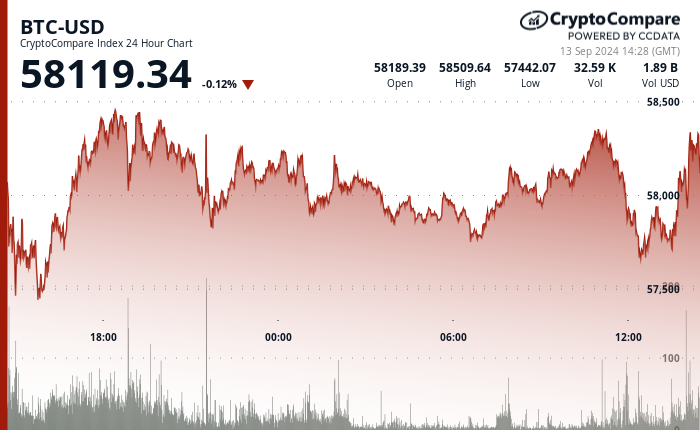
 
24 hours chart of the price of BTC
 

U.S. Treasury Withdraws Proposal for KYC Requirements on Unhosted Crypto Wallets


The U.S. Treasury Department has formally withdrawn a 2020 proposal to impose know-your-customer (KYC) requirements on non-custodial crypto wallets. This decision, finalized on August 19, concludes a years-long debate that originated in the last days of the Trump administration.

In December 2020, the Financial Crimes Enforcement Network (FinCEN), under then-Treasury Secretary Steven Mnuchin, introduced a rule that sought to extend KYC regulations to non-custodial wallets—wallets managed directly by individuals, without third-party intermediaries. The proposal faced immediate and broad opposition from the U.S. crypto industry, with critics arguing that the rule was technically unfeasible and excessively vague.

Thousands of comments were submitted in response to the proposal, emphasising that non-custodial wallets do not collect personal information, making compliance with KYC regulations difficult, if not impossible. The proposal was criticized for being out of step with the decentralized nature of blockchain technology.

The transition to the Biden administration in January 2021 significantly reduced the proposal’s momentum. The extended comment period allowed for further review and the rule was gradually sidelined, culminating in its official withdrawal this month.

Michael Mosier, a former acting director of FinCEN, told CoinDesk that the decision to withdraw the rule reflects a growing recognition of the government's need to adapt regulatory approaches to modern technologies rather than relying on outdated frameworks.

 
Read More
 

U.S. District Judge Says SEC's Lawsuit Against Crypto Exchange Kraken Must Proceed


Senior District Judge William H. Orrick of the U.S. District Court for the Northern District of California ruled on August 23 that the SEC has plausibly alleged that some cryptocurrency transactions facilitated by Kraken may qualify as investment contracts. This ruling allows the SEC’s lawsuit against the exchange, initially filed in November 2023, to proceed. The decision marks a significant legal hurdle for Kraken as it reportedly considers raising a final funding round before a potential initial public offering (IPO).

Judge Orrick acknowledged that the SEC’s labeling of Kraken’s tokens as “crypto asset securities” is “unclear at best and confusing at worst.” However, he interpreted the SEC’s claims as focusing on transactions involving investment contracts rather than on the classification of individual tokens as securities. This distinction is crucial, as it shapes the case’s direction and has implications for the broader crypto market.

Kraken’s Chief Legal Officer, Marco Santori, responded to the ruling on social media, celebrating the court's decision not to classify any tokens traded on Kraken as securities. Santori criticized the SEC’s approach, particularly its creation of the “crypto asset security” concept, and noted that the court questioned the SEC’s mischaracterization of Kraken’s stance.

Despite his criticisms, Santori acknowledged that the court allowed the case to proceed to the discovery phase. He pointed out that while tokens themselves aren’t securities, agreements surrounding them could be. This means the SEC must now prove that each transaction meets the criteria of the Howey Test—a challenging task that Santori believes will be difficult to achieve. He also warned that applying this standard across the crypto industry could lead to extensive litigation and emphasized the need for Congress to establish a clear regulatory framework.

 
Read More
 

TON Price Plummets After Telegram Founder and CEO Pavel Durov’s Arrest in France
 

The arrest of Telegram founder and CEO Pavel Durov in France has led to a significant drop in the value of the cryptocurrency Toncoin ($TON), which is closely connected to the Telegram messaging platform through The Open Network (TON), a blockchain project originally developed by Telegram.

The Open Network, originally developed by Telegram, is designed to be a scalable and user-friendly ecosystem for decentralized applications (dApps). Its native cryptocurrency, Toncoin, plays a crucial role within this ecosystem, facilitating transactions, executing smart contracts, and enabling network governance. TON's unique multi-blockchain architecture allows it to process millions of transactions per second, making it a versatile platform for developers and businesses.

After facing regulatory pressures, Telegram stepped back from the project, leading to a rebranding and the management of TON by the TON Foundation. Despite this, Toncoin remains integrated with Telegram, offering users features like commission-free crypto transfers through the TON Wallet.

Durov was arrested at Bourget airport near Paris, reportedly due to an investigation into Telegram's lack of moderation, which authorities believe has allowed criminal activities to go unchecked. Durov, who founded Telegram in 2013, has been a strong advocate for privacy and freedom of speech, often resisting governmental demands to censor content.

Telegram's role in regions like Russia and Ukraine, particularly since the start of the Russia-Ukraine conflict in February 2022, has made it a key platform for unfiltered information but also a target for increased scrutiny from governments concerned about security and misinformation.


Read More

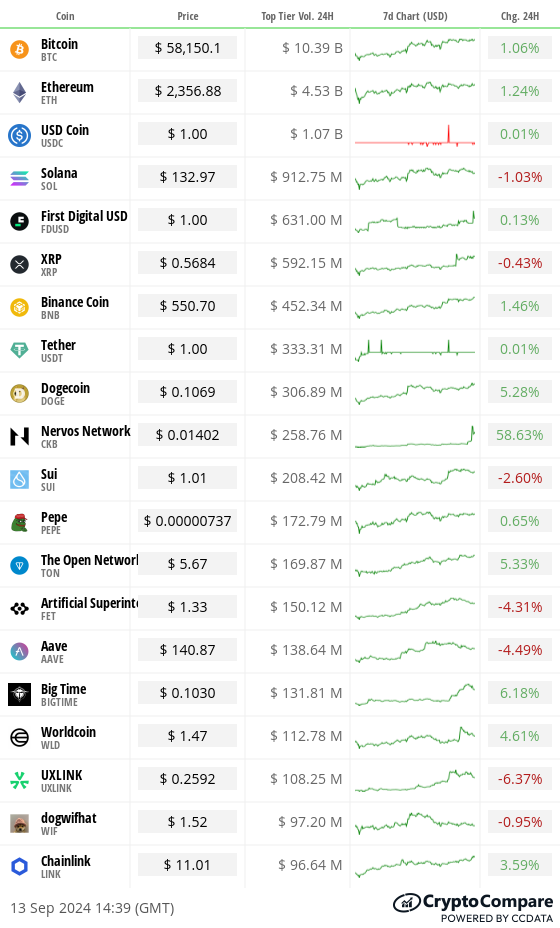
State of the Crypto by Top Tier Exchange Volume

Toplist 20 coins by top tier volume

Build your project with CoinDesk Data

 
social icon twitter social icon linkedin
 

Terms | Privacy

13 Charles II St, SW1Y 4QU

London, UK

This email may include advertisements by third parties. None of the advertised or promoted products and services have been verified or approved by us and this email is not any endorsement by us of the third party or of their products or services.


Download our App from the google play store
 
 
Download our App from the apple store